


Table of Contents
- What is order-to-cash?
- Signs your order-to-cash process needs attention
- How can organisations replace manual, fragmented order-to-cash workflows?
- Why is a manual order-to-cash process dangerous?
- Why do organisations tolerate poor order-to-cash workflows?
- Who owns order-to-cash end-to-end?
- What is the cost of a manual order-to-cash system?
- Why you can’t just automate order-to-cash?
- Why start with order-to-cash basics?
- What roadblocks are in a manual order-to-cash system?
- How to fix order-to-cash basics?
- Why is a compliance-based process important?
- Why are the boring deliberate improvements essential?
- How do informed choices transform order-to-cash?
Should CEOs focus on implementing AI technology or order-to-cash process basics?
Published: 24th February 2026
In this timely, pragmatic piece, Fanni Vig, Managing Director, UK, of Cegedim Business Services, argues that the fastest route to better cash flow, fewer disputes and more resilient operations isn’t chasing the next AI layer, but fixing the unglamorous basics: clean orders, consistent data, fewer exceptions and end-to-end visibility. The article offers an executive lens on why order-to-cash remains “messy” in otherwise successful businesses, and a clear, non-ideological path to improvement that makes automation (and AI) genuinely additive rather than cosmetic.
What is order-to-cash?
Order-to-cash (O2C or OTC) is the end-to-end business process that spans from the moment a customer places an order to reconciling the final payment. It covers the entire cycle from order placement, fulfillment, and invoicing to accounts receivable. Effective O2C streamlines supply chains, boosts cash flow, and improves customer satisfaction. A common example is a retailer selling goods: receiving an online order, picking and packing items, shipping, invoicing, and receiving payment.
Signs your order-to-cash process needs attention
- Frequent re-keying of orders or invoices
- More than 2–3 % of invoices disputed
- Order-to-cash cycle time creeping up
- Exception queues and shared inboxes overflowing
- Multiple “sources of truth”
- Late, partial or manual cash application
- Limited real-time visibility
- Workarounds are business-critical
- Compliance anxiety
- Talent burn-out signals
How can organisations replace manual, fragmented order-to-cash workflows?
The AI era is forcing leaders to rethink what “transformation” really means. Yet in many successful businesses, order-to-cash, a process that turns customer demand into revenue and revenue into cash, is still held together by manual re-keying, fragmented documentation and informal workarounds.
The result is subtle operational drag: disputes that linger, invoices that slip, forecasting that can’t be trusted, and cash that arrives late or is applied by hand. Fixing this isn’t about silver bullets. It’s about seeing the process end-to-end, restoring ownership across teams, and rebuilding the foundations, where automation supports the business rather than disrupting it, and AI becomes a multiplier on top of a process that works.
Why is a manual order-to-cash process dangerous?
Walk into almost any large organisation, and you will find two stories being told at once.
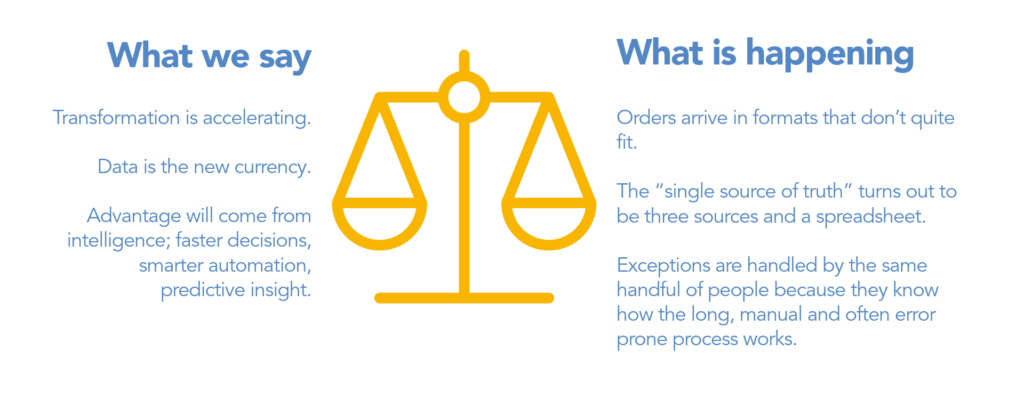
The first is the story we like to tell ourselves: transformation is accelerating, data is the new currency, and the next decisive advantage will come from intelligence; faster decisions, smarter automation, predictive insight.
The second story is the one playing out, quietly, in the operational backrooms of the same business: orders arrive in formats that don’t quite fit; the “single source of truth” turns out to be three sources and a spreadsheet; exceptions are handled by the same handful of people because they know how the long, manual and often error prone process works.
But which is true? It is possible for both stories to be true. In fact, it is increasingly common. That is what makes the current AI moment so interesting. Boston Consulting Group’s latest AI Radar report shows 65% of CEOs rank accelerating AI among their top three priorities (bcg.com, 2026).
I understand the pull. I share the belief that AI will change how work gets done, and at speed. But I also spend time with organisations where, in one of the most business-critical flows in the supply chain, the fundamentals are still operating on goodwill and manual effort. The basic mechanics of turning demand into revenue, and revenue into cash, can be far less modern than the rhetoric suggests.
In very normal, very successful businesses, this is still happening every day. Orders come in by email, PDF or portal. Someone re-keys them. Shipping notes don’t quite match the order. Invoices go out late or with errors. Disputes bounce between teams. Cash is applied manually. And a lot depends on a few people who “know how things work”.
We are talking about optimisation and intelligence while still struggling with a basic operational question: How do we deliver the right things, invoice the right things, and get paid, without manually managing every step along the way?
Why do organisations tolerate poor order-to-cash workflows?
Nobody thinks this process works well. I don’t hear people saying, “our order-to-cash process is working beautifully.” What I hear instead is more honest and more human: “It’s messy.” “We know it’s painful.” “Changing it would be a nightmare.”
Research has shown this the problem is real with the Department of Business and Trade confirming that delayed and unpaid invoices cost SMEs £22,000 per year (DfBT, 2024) and 56 million hours of lost productivity (Intuit Quickbooks, 2019).
The striking thing is that this isn’t denial. It is recognition paired with fatigue. People are not unaware of the problem. But the process has often become so convoluted – shaped by legacy systems, quick fixes, acquisitions, regional differences, changing customer requirements, and shifting compliance rules that it is difficult even to see the real flow clearly, let alone fix it. When something is complicated enough, it becomes easier to live with the pain than to open it up.
And because order-to-cash touches so many parts of the organisation, the pain is distributed. A delay here, an exception there, an invoice hold in one team, a dispute in another. No single moment feels catastrophic. Over time, it becomes “just how it is”.
Who owns order-to-cash end-to-end?
Part of the problem is ownership, or rather, the lack of it. Orders, invoices and cash do not live in one team.
- Sales cares about getting the order in and pricing.
- Operations cares about shipping the product and efficient resource planning.
- Finance cares about invoicing and getting paid.
- Customer service deals with disputes.
- IT owns the systems underneath it all.
- Each team is doing its job.
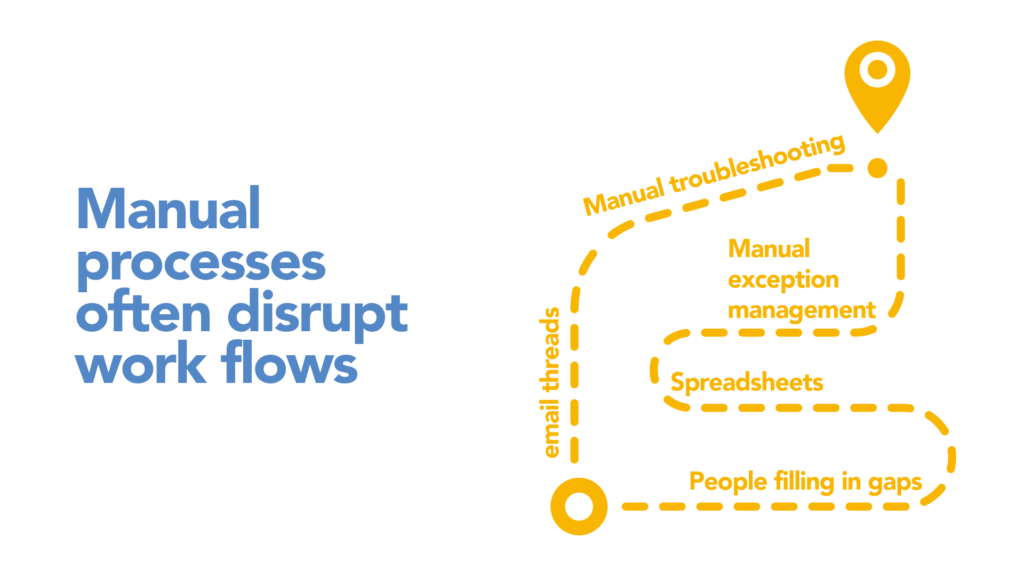
The issue is that the end-to-end flow often belongs to no one. When there is no single view of the full chain, the process ends up held together by informal glue: email threads, spreadsheets, manual troubleshooting, manual exception management, and people filling in gaps that shouldn’t exist. APQC benchmarking data cites organisations with manual processes spend 3-times more per invoice than automated organisations (APQC, 2023)
This can appear workable for a long time. But it is fragile. It works until the business starts selling more products, into more countries, through more channels. Then the improvisation that was once manageable becomes a constraint.
The aspirational business growth is actually exposing where the seams are starting to split.
What is the cost of a manual order-to-cash system?
Manual or semi-manual processes don’t usually fail loudly; they fail quietly. They show up as delays that feel normal, as errors that get worked around, as disputes that take weeks instead of days, as forecasting that is limited or unreliable because inputs are late or inconsistent, as payments that arrive late or land in the wrong place and require manual correction.
It is tempting to reduce this to a simple business case about cost per transaction. But the real cost is not only the processing cost. It is the organisational drag that sits in the middle of every day.
When a process is unclear, people spend an extraordinary amount of time on work that exists only because the process isn’t clear. The most capable individuals become the ones most at risk of burnout, because they are the ones everyone calls when an exception falls between cracks.
- They chase information.
- They reconcile versions of the truth.
- They fix preventable issues again and again.
- They build workarounds and then become dependent on the workarounds.
This is why I often describe the situation like this: good people end up doing coping work instead of meaningful work.
That is a hard thing to accept as a leader, because it suggests the business is consuming talent on tasks that add no strategic value. Yet it is precisely what happens when the operational basics are not stable.
The financial implications follow quickly. Disputes are not just “admin”; they are one of the most direct ways cash gets trapped. Simply put, a disputed invoice can have a negative impact on cash flow because customers withhold payment until the dispute is resolved; if disputes are not handled promptly, the impact can become significant. The longer the ambiguity persists, the longer the cash remains out of reach.
Why you can’t just automate order-to-cash?
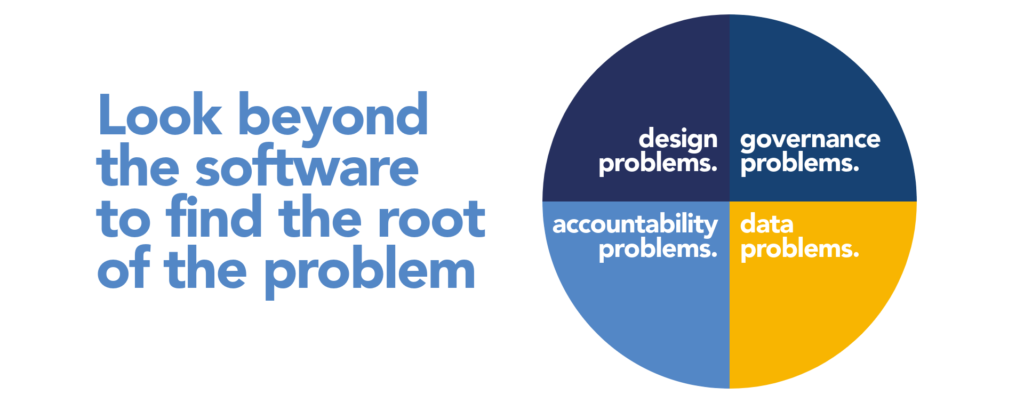
At this point, automation and increasingly AI often get positioned as the answer. Yet these issues are not hard to fix because the technology doesn’t exist. They are hard because fixing them means changing how teams work together, understanding processes that are often hidden or wrongly assumed, and surfacing workarounds people rely on. In other words, order-to-cash problems are rarely “software problems” first.
They are;
- design problems.
- governance problems.
- accountability problems.
- data problems.
- And they sit in the gaps between functions.
This is where AI narratives can become unhelpful. If orders are inconsistent, invoices don’t line up, and data is late or incomplete, AI does not help. It just gives you faster answers to the wrong questions. It accelerates the visible layer without repairing the foundations beneath.
There is a phrase that I find myself returning to: you can’t optimise what you can’t trust. If the organisation cannot trust the order data, cannot trust that fulfilment events are captured consistently, cannot trust that references align across documents, then any “intelligence” applied downstream becomes guesswork. It may look sophisticated, but it will not be reliable. In financial operations, unreliability is not a minor inconvenience. It becomes a risk.
Why start with order-to-cash basics?
The unglamorous truth is that the work that changes everything is rarely exciting. It is the work of making inputs clean and consistent, reducing manual exceptions, reducing manual touchpoints, and creating visibility across the whole flow. It is the work of building a transaction process that can scale.
That process starts earlier than most people assume. It starts at order capture, where the organisation decides whether it will accept ambiguity as a normal cost of doing business or whether it will insist on clarity upfront. Clean, ERP-ready orders are not a nice-to-have. They are the first control point in the chain. If the order is inconsistent, every downstream step becomes more expensive: fulfilment becomes harder to reconcile, invoicing becomes harder to validate, disputes become harder to resolve, and cash becomes harder to apply.
The process continues through fulfilment, where the business needs a consistent thread of evidence that what was ordered is what was delivered, and then onto invoicing, which should be the controlled output of a reliable flow rather than a manually created task, built from partial information. And it continues through dispute handling and cash application, where the organisation either has structured workflows and shared visibility, or it relies on inboxes and memory.
This work is not glamorous precisely because it is foundational. Yet it is also the work that unlocks everything else. When friction reduces, people feel it quickly. When the basics become stable, automation becomes support rather than disruption. And when the basics become stable, then AI begins to make sense. Not as a rescue plan, but as a multiplier.
What roadblocks are in a manual order-to-cash system?
The hardest part of order-to-cash is not usually the endpoints. Leaders can describe how an order should be taken and how revenue should be recognised. They can describe invoicing, payment terms and collections. The challenge comes in the messy middle: everything between customer intent and cash in the bank, where the lived process diverges from the diagram.
This messy middle is where complexity accumulates.
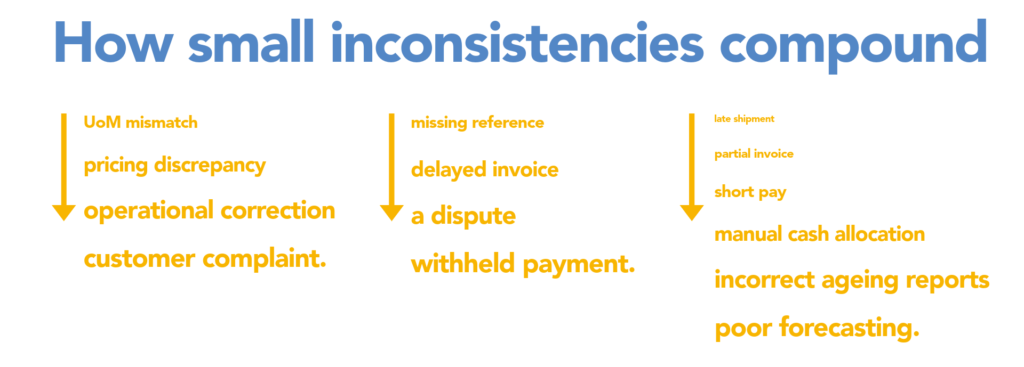
- It is where small inconsistencies compound. It is where a missing reference becomes a delayed invoice, which becomes a dispute, which becomes withheld payment.
- It is where a unit-of-measure mismatch becomes a pricing discrepancy, which becomes an operational correction, which becomes a customer complaint.
- It is where a late shipment triggers a partial invoice, which triggers a short pay, which triggers manual cash allocation, which triggers incorrect ageing reports, which triggers poor forecasting.
If the messy middle is invisible, improvement becomes guesswork. Organisations tend to focus on what they can see: a new billing tool, a new analytics layer, a new automation pilot. But the real impact comes from making the flow visible end-to-end and then identifying where friction causes the most damage.
That is why I believe the right starting point is not “fix everything at once”. It is to make informed decisions about what to fix first, based on reality. Fixing these processes means making the real process visible, identifying where friction causes the most damage, deciding deliberately where to fix the problem (whether in the ERP, in EDI, in middleware, or in the way teams collaborate) and then sequencing improvements so each change reduces the burden on the next.
How to fix order-to-cash basics?
Fixing the basics is not about minor tweaks. It is about coherence.
Coherence begins with standardisation of the information that matters: product identifiers, units of measure, customer and delivery location codes, pricing terms, tax and legal entity data, and the references that allow documents to be traced across the chain. When those elements are inconsistent, organisations end up debating reality rather than executing it. When those elements are consistent, the organisation can move faster because it spends less time interpreting what a transaction “really means”.
Coherence also requires validation. A great deal of downstream pain is created by upstream ambiguity that could have been caught earlier. That is why validation at the point of entry (or at least before data hits core systems) is so powerful. It reduces the number of exceptions that need to be managed later and changes the organisational workload from constant correction to controlled prevention.
Then there is the question of exception handling. Exceptions are inevitable. What is not inevitable is the way they are handled. In many organisations, disputes “bounce between teams” not because people are careless, but because the organisation has not designed a clear workflow that reflects reality. A mature approach gives disputes a structured path: a shared view of the transaction history, clear ownership, reason codes that create learning rather than noise, and service levels that prevent problems from lingering.
Finally, there is cash. Cash application is the point where financial truth is finalised, yet it is often the part of the flow most dependent on manual effort and tribal knowledge. When remittance information is inconsistent, when payments do not reference invoices clearly, or when customers aggregate payments, finance teams end up doing time-consuming matching work that exists purely because earlier standards were not enforced. Improving this step is not just about efficiency; it is about enabling reliable receivables visibility and forecasting.
Why is a compliance-based process important?
There is another reason the basics matter more now than they did even a few years ago: compliance expectations are moving towards greater structure and auditability.
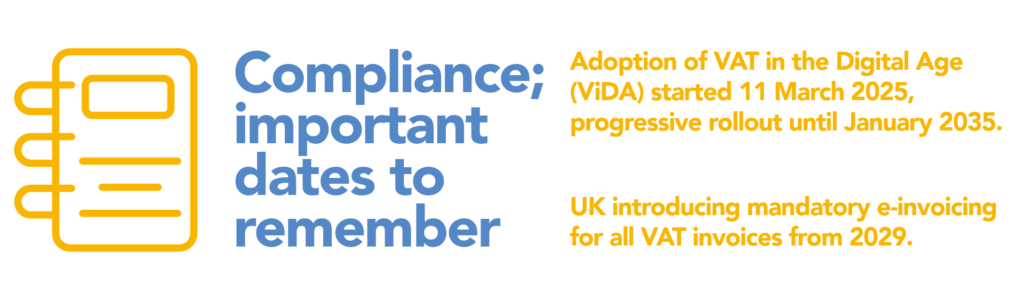
Across Europe, the shift towards digital reporting and e-invoicing is accelerating. The European Commission announced the adoption of the VAT in the Digital Age (ViDA), (Eurpean Comission, 2025) package on 11 March 2025, with progressive rollout until January 2035. Whatever your view on policy, the operational implication is clear: invoice data and transaction reporting are becoming more standardised, more controlled, and more scrutinised over time.
In the UK, the government’s consultation response on promoting electronic invoicing states that, as announced at Budget 2025, the UK will introduce mandatory e-invoicing for all VAT invoices from 2029. Professional bodies have reinforced that direction and outlined how the requirement is expected to apply across VAT transactions in scope.
This matters because it reframes the “basics” as something more than operational housekeeping. Clean, consistent, traceable transactions are becoming a compliance requirement. Audit trails are no longer a by-product; they are a design goal. In that environment, informal processes that rely on emails and spreadsheets are not just inefficient. They increasingly look like a risk.
Why are the boring deliberate improvements essential?
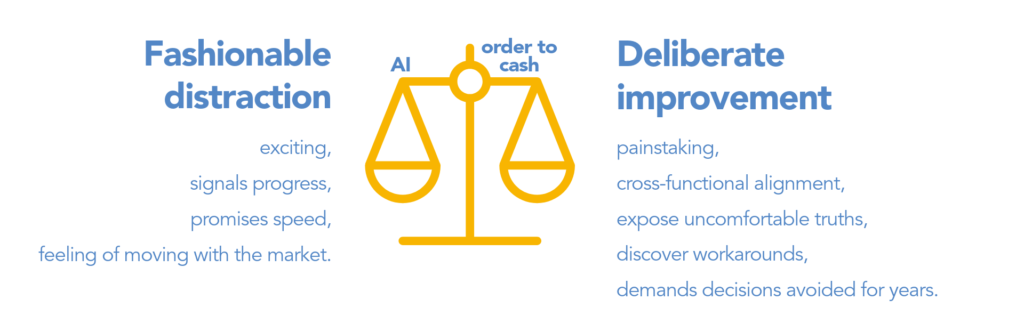
It is worth pausing on the psychology here. AI is exciting. It signals progress. It promises speed. It makes leaders feel they are moving with the market. The basics of order-to-cash are the opposite:
- They are painstaking.
- They require cross-functional alignment.
- They expose uncomfortable truths about how work actually happens.
- They surface workarounds that people rely on.
- They often demand decisions about standards, ownership, and governance that have been avoided for years.
That is exactly why they are so powerful.
This isn’t just about buying tools. It is about deciding that friction isn’t “just how things are” and that people’s time and the business’s cash are too valuable to waste. It is about accepting that the most effective transformation programmes feel “boring” in the best way: fewer exceptions, fewer disputes, fewer frantic chases for information, and a more reliable view of performance.
And it is about sequence. When organisations try to optimise before they stabilise, they create frustration. When they stabilise first, optimisation becomes natural. This means putting the basics in place so automation doesn’t feel threatening; it is a reliever of friction, frustration and failures. When the basics are in place, AI becomes not a headline, but a practical capability applied safely to clear use cases.
How do informed choices transform order-to-cash?
Fixing order-to-cash isn’t about small tweaks or silver bullets. It’s about understanding the real process end-to-end and making informed decisions about what to fix first within the process as a whole. The reason I insist on that framing is that it returns transformation to its proper place: not as a technology race, but as a discipline of operational design.
Everyone already knows the process isn’t great. The difference is choosing to face it end-to-end, and to improve it deliberately with one informed decision at a time. That choice is what separates organisations that build resilience and cash performance from those that simply add more layers of tooling on top of friction.
AI will undoubtedly change the way we work. But if we want it to matter in order-to-cash, we need to be honest about the foundation it sits on. Fix the basics, and AI becomes a multiplier. Ignore the basics, and AI becomes a faster route to confusion.
The most advanced organisations are not the ones chasing the newest idea first. They are the ones who have the discipline to make the fundamentals coherent so that when they do invest in intelligence, it has something reliable to work with.
While the pressure to “accelerate AI” is continually rising, that may be the most quietly radical leadership decision of all.
Ready to improve your order-to-cash workflow? Click the button below and schedule a 20-minute discovery call.
In Summary
Tidy the foundations before adding AI.
AI and advanced analytics only create real value when orders, fulfilment and invoicing data are already clean, consistent and traceable; otherwise they simply accelerate bad information.
Hidden manual effort drains cash and talent.
Re-keying, spreadsheet fixes and endless exception chases quietly erode working-capital, delay revenue, and burn out the very people who keep the process afloat.
End-to-end ownership is missing.
Order-to-cash touches sales, operations, finance, customer service and IT, yet no single team is accountable for the whole journey, so gaps in data, governance and accountability become the process itself.
“Just automate it” fails without standardisation and validation.
Product codes, units of measure, location references, tax and pricing terms must be standardised and validated at source; only then can automation (and later AI) reduce effort rather than create rework.
Regulation is raising the bar.
EU ViDA and forthcoming UK e-invoicing mandates are turning structured, auditable transaction data from a nice-to-have into a legal necessity; informal email-and-PDF workflows are now a compliance risk.
Progress is deliberate, not flashy.
The organisations that out-perform stabilise first and optimise second, sequencing improvements one informed decision at a time so that automation relieves friction and AI becomes a genuine multiplier.
About the Author

Fanni Vig, Managing Director, UK, of Cegedim Business Services
Creative and future-oriented leader with 15+ years of success leading high performing teams and delivering ambitious growth plans, helping various technology companies experience accelerated expansion by producing strategic blueprints and providing profitable international growth plans.
Noteworthy achievements include:
- Finalist: Women in Tech Awards.
- Exited a business for a six-figure sale by building a consultancy business in data analytics.
- Identified as a High-Potential Leader as part of the Logicalis Global Leadership Programme.