

Executive summary
Electronic Data Interchange (EDI) is no longer just a cost-saving alternative to paperwork. In 2026 it is the foundation for real-time, compliant, purchase-to-pay automation and is mandatory in certain industries. This guide explains the standards, benefits, mandates and next steps.
What is EDI?
Electronic Data Interchange (EDI) is the structured, computer-to-computer exchange of business documents (orders, invoices, ASNs and more) in a standard digital format. It removes manual key-in, fax and PDF email, allowing trading partners’ ERP or finance systems to talk directly.
Any organisation that buys, sells or moves goods or services at scale — retail, healthcare, manufacturing, logistics, public sector — gains from lower processing costs, faster cycles and better data accuracy.
Fast-track history: 1960 – 2026
From a Cold-War cargo manifest to today’s AI-enriched, API-enabled networks, the story of Electronic Data Interchange charts six decades of technical leaps and regulatory milestones. The timeline below distils those breakthroughs, showing how each era paved the way for the compliant, touch-free purchase-to-pay automation we rely on in 2026.
| Era | Key developments |
|---|---|
| 1960s | U.S. Army Master Sergeant Edward Guilbert pilots computer-to-computer shipment manifests for army logistics, the first practical EDI concept. |
| 1970s | Heathrow’s LACES freight system goes live (1971); File Transfer Protocol (FTP) published (1973); transport sector issues the first formal EDI standard, TDCC (1975). |
| 1980s | ANSI X12 released (1981) and widened for cross-industry use (1982); major retailers and automotive OEMs start mandating EDI from their suppliers. |
| 1990s | Commercial internet adoption lets businesses exchange EDI messages over TCP/IP, driving mainstream uptake. |
| 2000s | XML-based schemas and the AS2 protocol make EDI affordable for SMEs and pave the way for cloud VANs. |
| 2010s | Cloud-hosted managed services take hold; PEPPOL BIS becomes the de-facto standard for European public procurement. |
| 2020s | API–EDI hybrids, AI-driven data enrichment and real-time e-invoicing mandates (e.g. EU ViDA adopted 2025) reshape EDI into a compliance backbone. |
| Present (2026) | It's estimated that 9 in 10 large UK-listed companies now rely on EDI or PEPPOL for purchase-to-pay automation; modern platforms such as Netix blend EDI, API and low-code enrichment to deliver ERP-ready, audit-proof transactions. |
Core EDI standards & message types
EDI standards are predefined formats and rules that dictate how electronic documents should be structured and exchanged, ensuring consistency and uniformity, enabling seamless communication and data interpretation across various businesses and industries. Examples of widely used EDI standards include EDIFACT, Tradacomsl, ASC X12, VDA, PEPPOL BIS and SWIFT.
| Standard | Region/sector | Typical messages |
|---|---|---|
| EDIFACT (ISO 9735) | Global (favoured by UK grocery chains) | ORDERS – Purchase Order ORDRSP – Purchase Order Response ORDCHG – Purchase Order Change Request INVRPT – Inventory Report REMADV – Remittance Advice CREADV – Credit Advice |
| Tradacoms | UK (legacy UK retail) | ORDHDR – Order NVFIL – Invoice CREHDR – Credit Note DELHDR – Delivery Notification |
| ASC X12 | USA/Canada | 850 – Purchase Order 820 – Invoice 846 – Inventory Status 856 – Advanced Shipping Notice (ASN) |
| VDA | Germany (automotive supply chain) | VDA 4905 (delivery forecast) 4913 (ASN) 4939 (invoice) |
| PEPPOL BIS | Europe/Singapore (public procurement & e-invoicing) | BIS 3 Invoice Order Only Despatch Advice |
| SWIFT | Global (banking & paymen)ts | MT103 (customer credit transfer) MT940 (statement) |
How EDI works - five-step flow
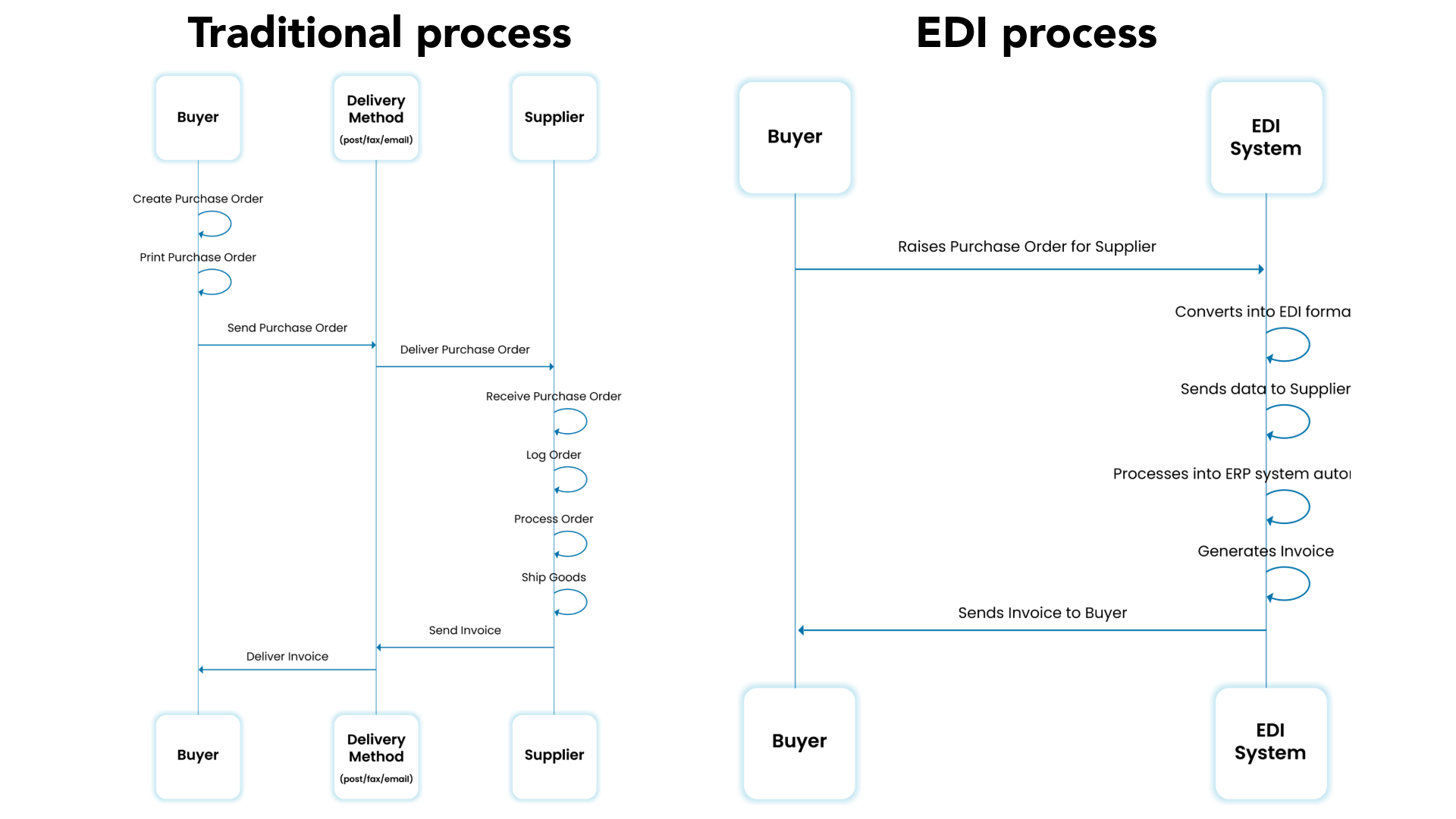
1. Document creation in the buyer’s ERP
2. Translation into the agreed standard (e.g. EDIFACT) via an EDI translator
3. Secure transmission over AS2, SFTP, VAN or PEPPOL network
4. Reception & re-translation by the supplier’s platform
5. ERP integration & acknowledgement — optional three-way matching and auto-posting
Nine proven benefits
Whether you are rationalising freight invoices or reconciling cross-border purchase orders, EDI delivers measurable, board-level results. The advantages span hard savings and soft resilience: from slashing per-transaction costs to providing the real-time audit trail auditors now expect under ViDA and UK Making Tax Digital. The nine points that follow capture the benefits of a digital supply chain.
Cost Savings
GS1 UK puts the savings at £14 per order and estimates over £650 million annual savings in the UK grocery industry by eliminating paper-based transactions, printing and postage costs, as well as the costs associated with personnel, supplies and storage.
Error reduction
Eliminating the need for manual data entry significantly reduces the likelihood of errors during traditional data handling. Studies have shown that up to 35% fewer chargebacks can be achieved thanks to data validation (CapMonster Cloud). This enhances data accuracy and improves efficiency, leading to quicker order processing, fewer delays, and improved overall productivity.
Cycle-time compression
There have been a number of studies across various industries exploring the benefits of implementing EDI, specifically around cost savings and speed. In 2010, GS1 prepared a report on electronic transactions in the supply chain and found that “what previously took up to 5 days, now takes a few minutes”. Technology has improved in the time since the report so if you’re not already utilising EDI you could be saving even more time and money.
Supplier satisfaction
Efficient and accurate transactions, facilitated by EDI, contribute to improved customer satisfaction and stronger business relationships with partners. Your supply chain will gain a better understanding of the exchanged information, fostering more productive relationships. Fewer queries, faster payment.
Other Benefits
Improved cash flow through quicker invoice approval.
Regulatory compliance – structured e-invoices satisfy ViDA & Making Tax Digital rules.
Scalability – supports surges without extra head-count.
Rich analytics – full audit trail for ESG and supply-chain reporting.
Sustainability – paperless processes cut carbon and postage.
Compliance landscape 2026
Regulators are transforming electronic invoicing from a best-practice efficiency play into a legal necessity. The table that follows highlights the mandates already in force and the deadlines looming through 2030.
| Jurisdiction | Mandate | Key dates |
|---|---|---|
| EU | ViDA - Digital real-time VAT reporting & cross-border e-invoicing. | Adopted 11 Mar 2025; phased 2028-2035. |
| France | B2B e-invoicing for large enterprises from Jul 2024, all companies by 2026. | |
| UK | HM Treasury consultation (Nov 2025) signals push for broad e-invoicing – small firms could save £11,300 a year. |
EDI plus API - why you now need both
Real-time stock checks, dynamic pricing and drop-ship models drive API adoption. Yet EDI remains the lingua franca for large retailers and logistics hubs. Netix bridges the two: its dual EDI/API engine and bespoke workflows and plug-ins create an enrichment layer delivering ERP-ready data without custom code.
Future trends to watch (2026-2030)
- AI-driven error-prediction and mapping diverse data formats:
Machine-learning models will flag anomalies before they hit the ERP and auto-build cross-standard mappings, slashing exception handling to near zero.
- Blockchain audit layers for high-value pharma & aerospace supply chains:
Shared, tamper-proof ledgers will guarantee provenance and recall traceability without costly third-party intermediaries.
- Low-code mapping libraries will democratise partner onboarding:
Drag-and-drop, template-driven libraries will let procurement and supply-chain teams configure data mappings themselves, shrinking onboarding cycles from months to days and easing the skills bottleneck for EDI specialists.
- End-to-end purchase-to-pay orchestration, not just document transport:
EDI solutions will automatically enrich data, run three-way matching, trigger approvals and reconcile payments in one continuous flow, eliminating manual hand-offs across finance, procurement and treasury.
Summary
EDI has evolved from batch file swaps to a strategic enabler of compliant, straight-through processing. By combining standards-based messaging with real-time APIs, organisations can cut running costs, achieve new VAT mandates and give finance teams the visibility they need.
Want to know more. Check these out...
See all


Want to know more?
Enter your details below or call us on +44 (0) 1772 977781